

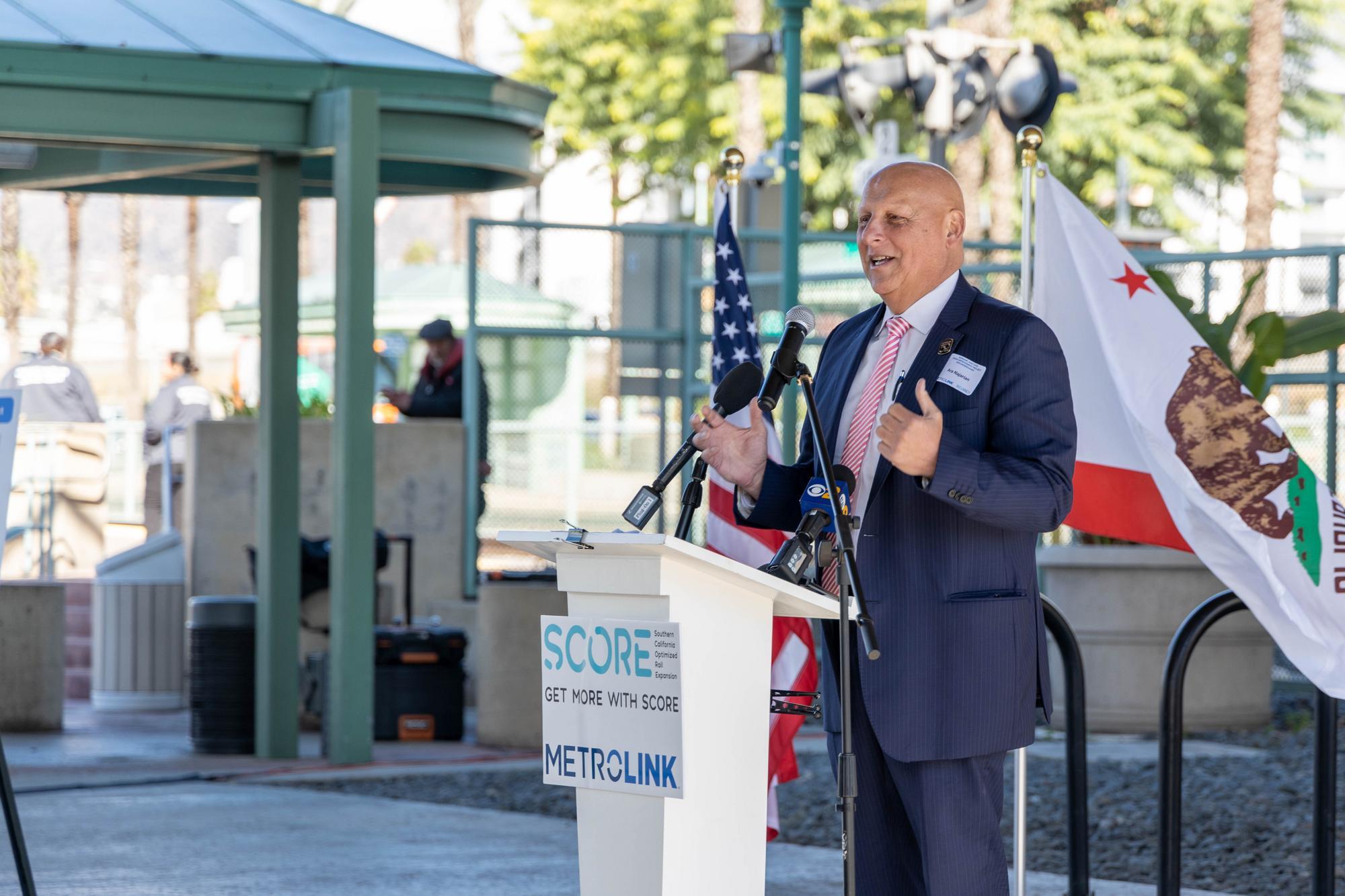
Board Director Ara Najarian speaks at the 2022 groundbreaking for the Burbank Junction Speed Improvement Project.
We recently spoke with Metrolink Board Member and Glendale Mayor Ara Najarian about his decades-long commitment to public service and regional transportation. He represents a station city along Metrolink’s Antelope Valley and Ventura County lines and has held leadership roles across Southern California’s transportation landscape, including past chairman of the LA Metro Board of Directors. Thanks to his many years as a civil servant and industry influencer, Director Najarian brings a unique perspective to the future of mobility in the region.
In our conversation, Director Najarian reflected on the importance of collaboration between agencies, the role of sound governance in protecting riders and public resources, and why expanding transit options is essential as Southern California continues to grow. He also shared his views on effective public leadership, emphasizing accountability and listening as cornerstones of meaningful community service.
1. In addition to your role on the Metrolink Board, you’ve worked across multiple transportation systems as a member and former chairman of the LA Metro Board of Directors and a Hollywood Burbank Airport Authority commissioner. From this unique vantage point, what is your vision for transportation in Southern California?
My experience with LA Metro and Burbank Hollywood Airport has reinforced how vital connectivity is for transportation throughout Southern California. In such a vast region, it’s rare that someone can reach their destination using just one mode of transit. Travelers typically need to switch between different types of transportation and agencies to complete their journeys. Most people don’t worry about which agency operates each segment—they just want to arrive efficiently. Working within three transportation agencies, I have gained valuable insight into the importance of strong cooperation and coordination between transit systems. As we strengthen these connections, travel will become easier and more enjoyable for everyone.
2. You’ve served multiple terms as Mayor of the City of Glendale, which is served by two Metrolink lines, and are deeply involved in regional transportation leadership. How does your perspective shape your work on the Metrolink Board of Directors?
Serving five terms as Glendale Mayor has given me a deep understanding of the importance of having safe, reliable, and affordable passenger rail service. It has also provided valuable insight into how best to collaborate with other Board members, many of whom are fellow mayors or county supervisors. Working effectively with the other directors is essential to serving on the Metrolink Board. The Board’s positive working relationship makes being part of Metrolink truly enjoyable.
3. With decades of legal and public service experience. How has that background shaped your approach to governance and oversight at Metrolink?
I have worked as an attorney for more than 40 years. My legal expertise gives me a distinctive viewpoint on the Metrolink Board. I remain attentive to matters that could put riders at risk or expose the agency to liability. Along with former Board member Keith Millhouse, I played a crucial role in guiding Metrolink through complex legal and insurance challenges following a tragic incident near Chatsworth in 2008, which led the rail industry to mandate new train-control technology and stronger safeguards. I firmly believe that every governing body benefits from having an experienced attorney on its board.
4. Southern California faces unique challenges with traffic congestion and long commutes. What would you say to someone who is frustrated by their experiences on the roadways but hasn’t yet made the jump to public transportation?
Traffic congestion in Southern California is unlikely to improve given the ongoing population growth and geographic expansion. Freeways are approaching maximum capacity in many regions, and as observed at LA Metro, adding highway lanes does not alleviate traffic; rather, it tends to encourage greater vehicle use rather than promoting public transit, carpooling or adjustments to commute times. This phenomenon is known as supply-induced demand—expanding roadways leads to more drivers on the road.
Recognizing this, it is essential to focus on the future of transit solutions. Southern California has an extensive transit network that reaches most destinations. Agencies have invested billions of dollars in these systems, understanding that transit options will become increasingly vital for timely travel. Residents are encouraged to utilize services such as Metrolink or LA Metro buses and trains, even if only once a week initially, gradually increasing usage as familiarity grows. Using public transit can positively impact daily life.
5. From your perspective, what are the three most important qualities of an effective leader in public service?
An effective public service leader prioritizes ethics, honesty and integrity. Entrusted with public resources and tax dollars, leaders must manage these assets with the highest level of accountability. Every decision should be made in pursuit of the greater public good.
A strong leader remains devoted to advancing the public interest, valuing the community’s long-term welfare above short-term gains. When making decisions, it is essential to actively listen to and consider the perspectives of all stakeholders, ensuring that outcomes benefit the larger population rather than a select group.
Moreover, successful leadership in public service is collaborative and open to working alongside colleagues. Leaders must communicate their viewpoints clearly and concisely to build support within board deliberations, both on and off the dais. Additionally, effective leaders seek guidance from knowledgeable and experienced staff who frequently possess deeper insights into issues than elected officials.