

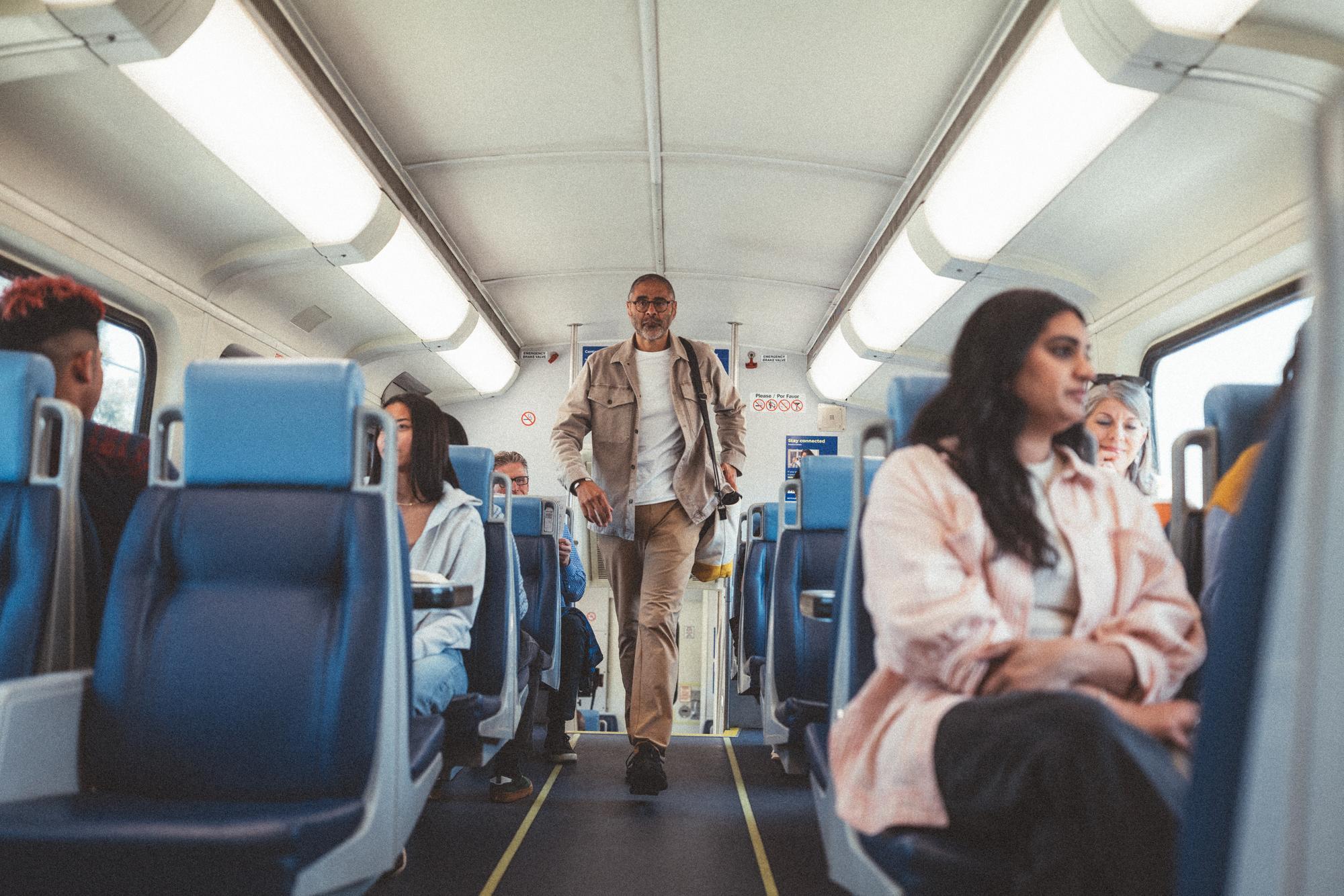
A Metrolink rider looks for a seat on board the train as it prepares to depart the station.
At Metrolink, our mantra is “safety is foundational.” And we mean it. That commitment extends beyond infrastructure and operations to the security and well-being of everyone who interacts with our system, including passengers, crew members and the general public.
In 2025, Metrolink continued a proactive, data-driven approach to safety initiatives, achieving a 22% reduction in unruly passenger incidents and a 47% reduction in fare evasion compared to the prior year. These gains reflect close coordination between Metrolink’s safety, security and compliance team and public and private partners, including the Los Angeles County Sheriff’s Department, Metrolink Bureau, the San Bernardino County Sheriff’s Department, Alstom, Allied Universal Security Services and more than 40 law enforcement agencies across the region, ensuring resources are deployed where they are most effective.
Metrolink’s safety strategy recognizes that customers consistently rank personal security as a top factor when choosing public transportation. While interpersonal crime on Metrolink’s system remains rare, occurring on less than one-tenth of one percent of the more than 48,000 trains Metrolink operated in 2025, our agency remains vigilant. We employ an agile, data-driven model, with all reported incidents logged in our safety database and analyzed biweekly to identify trends and determine where targeted enforcement is most needed.
Metrolink passengers may also notice safety in action through several ongoing, high-visibility initiatives. To help enforce fare compliance, “Street Carring” operations at key locations, including Los Angeles Union Station, and end-of-line stations in San Bernardino and Lancaster, position security officers at a single point of entry to conduct visual ticket inspections while customers board. Law enforcement personnel frequently arrive 10 to 15 minutes before trains at major stations to patrol platforms, interact with passengers and deter incidents before they occur. Metrolink is also piloting a dedicated fare enforcement team to patrol stations, perform visual fare checks, assist passengers and maintain a strong safety presence.
Following a historic service expansion in late 2024, Metrolink’s data-backed approach was instrumental in reducing vehicle and pedestrian strikes per train operated last year. As part of our sustained efforts to keep riders and community members safe, we actively communicate safety guidance to customers and the public throughout the year – from physical signage onboard the trains to outreach near tracks emphasizing situational awareness and crossing safety features.
Safety is not an end state, but a continuous effort that takes shared commitment and vigilance. Whether you are onboard a Metrolink train or find yourself near railroad tracks, here are a few practical reminders to help you stay safe:
- Watch your step and use handrails, maintaining two points of contact when making your way through the train.
- Stay alert around railroad tracks. Don’t use your phone or wear headphones. Avoid any other distractions that would prevent you from hearing or seeing an approaching train.
- Never walk along railroad tracks or trespass to capture photo or video content. It’s not only dangerous, but it’s also illegal.
- If you’re going to cross railroad tracks, always do it at a designated crossing. Never try to bypass an activated crossing’s safety features – if the gates are down, it’s to keep you out of danger.
- If the train is stopped between stations, you should stay on board unless instructed to evacuate by the crew or law enforcement, or if imminent danger is present. The rail right-of-way contains many hazards like loose rocks providing unstable footing and live train traffic where multiple tracks run parallel.